
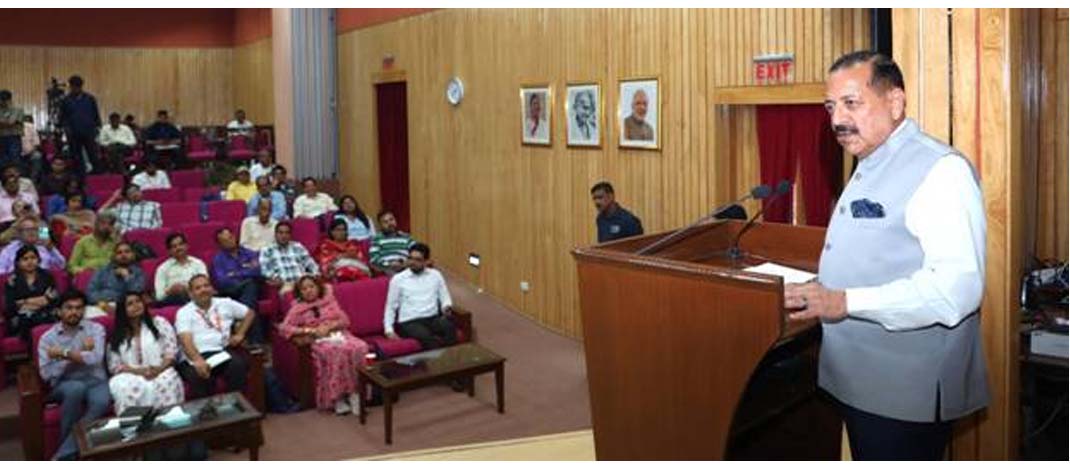
New Delhi : Union Minister of State (Independent Charge) for Science & Technology and Earth Sciences, Dr. Jitendra Singh, on Tuesday launched two advanced weather forecasting products developed under the Ministry of Earth Sciences (MoES), aimed at delivering hyper-local, impact-based and AI-driven weather services across India.
The newly launched systems include the India Meteorological Department’s (IMD) first Artificial Intelligence-enabled “Forecast of Monsoon Advance over Different Parts of the Country” and a pilot “High Spatial Resolution Rainfall Forecast for Uttar Pradesh.” The products have been jointly developed by the India Meteorological Department (IMD), Indian Institute of Tropical Meteorology (IITM), Pune, and the National Centre for Medium Range Weather Forecasting (NCMRWF).
Speaking at the launch event in New Delhi, Dr. Jitendra Singh said India’s weather forecasting capabilities have undergone a major transformation over the past decade due to technological advancements, better data integration and improved forecasting models. He said IMD has evolved into a critical institution supporting governance, disaster management, agriculture planning and day-to-day public decision-making.
The Minister said the newly introduced systems represent a shift from conventional weather forecasting to impact-based and decision-support forecasting, capable of providing precise, location-specific and actionable weather information to farmers, disaster managers, administrators and the general public.
The launch event, held at Mahika Hall in the Ministry of Earth Sciences, was attended by Secretary, Ministry of Earth Sciences, Dr. M. Ravichandran; Director General of Meteorology, IMD, Dr. Mrutyunjay Mohapatra; Director, IITM Pune, Dr. Suryachandra Rao; along with senior scientists, officials and media representatives.
Highlighting the rapid modernization of weather infrastructure in the country, Dr. Jitendra Singh said India had only around 16 to 17 Doppler Weather Radars a decade ago, while the number has now increased to nearly 50, with another 50 planned under Mission Mausam. He added that the expansion of radar networks, automatic weather stations, high-performance computing systems and digital dissemination platforms has significantly improved forecasting and early warning capabilities nationwide.
The AI-enabled monsoon forecasting system will provide probabilistic forecasts of monsoon advancement every Wednesday, up to four weeks in advance. The service has been designed to support farmers across 16 States and more than 3,000 sub-districts through the dissemination framework of the Ministry of Agriculture and Farmers’ Welfare. According to the Minister, the system combines AI-based forecasting models, extended-range prediction systems and statistical methods to provide practical support for agricultural planning and preparedness.
The second product, a high spatial resolution rainfall forecasting system for Uttar Pradesh, has been introduced as a pilot project capable of generating rainfall forecasts at a 1-kilometre spatial resolution up to 10 days in advance. The system integrates data from Automatic Rain Gauges, Automatic Weather Stations, Doppler Weather Radars and satellite-based rainfall datasets using advanced AI-driven downscaling techniques.
Dr. Jitendra Singh said the initiative would prove beneficial for agriculture, water resource management, renewable energy, urban planning, disaster management and infrastructure sectors. He added that farmers would now be able to make more informed decisions regarding sowing, irrigation, crop protection and harvesting with much greater local accuracy.
The Minister noted that India has recorded nearly 40 per cent improvement in severe weather forecast accuracy over the past decade. He also said cyclone track, intensity and landfall prediction accuracy for 72-hour forecasts has improved by around 30 to 35 per cent in the last five years, while seasonal forecast errors have reduced considerably.
Referring to increasing climate variability and extreme weather events, Dr. Jitendra Singh stressed the need for scientifically advanced forecasting systems capable of supporting real-time public and administrative decision-making. He said the Government under Prime Minister Narendra Modi has undertaken several major initiatives, including Mission Mausam, expansion of radar networks, modernization of observational systems and strengthening of high-performance computing facilities to create a robust, technology-driven forecasting ecosystem.
He further stated that weather advisories and early warnings are now being disseminated through multiple platforms such as mobile applications, SMS alerts, WhatsApp, Kisan portals, television and digital channels to improve public outreach and last-mile connectivity.
Secretary, Ministry of Earth Sciences, Dr. M. Ravichandran, said the newly launched products are stakeholder-driven systems developed using a combination of numerical weather prediction models and AI-based approaches. He added that the monsoon forecasting system would provide granular district-level forecasts, while the Uttar Pradesh pilot demonstrates the capability of generating operational rainfall forecasts at 1-km resolution using dense observational networks and AI techniques. Similar services, he said, would gradually be expanded to other parts of the country.
Dr. Jitendra Singh said the launch of these forecasting products marks another important step towards building a climate-resilient, digitally empowered and citizen-centric weather service ecosystem in India, where scientific innovation directly contributes to public welfare and economic growth.